
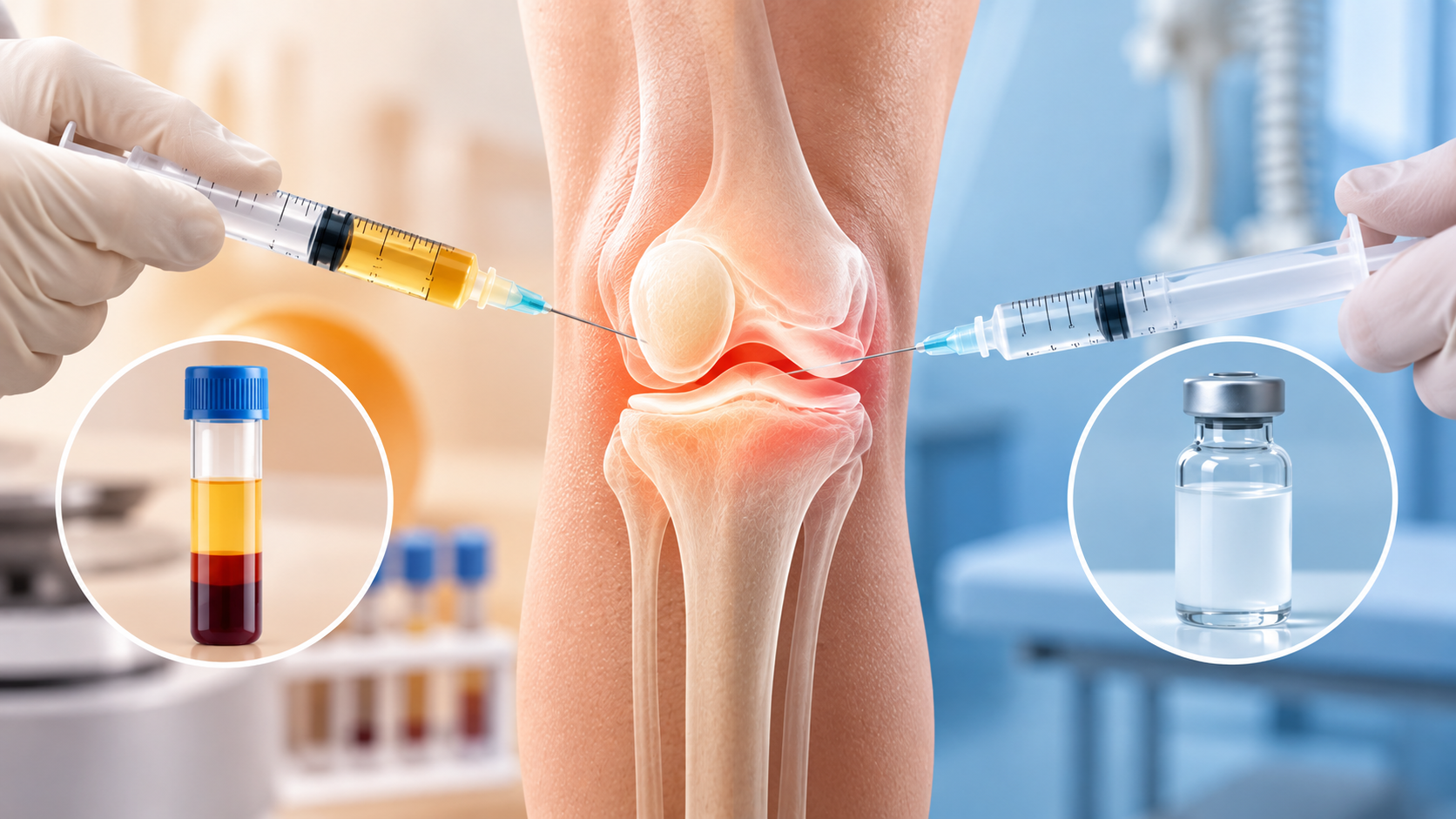
You've been favoring a knee for months. Physical therapy helped some, but not enough, and surgery feels like jumping ahead. Somewhere in your research you've landed on two names that keep coming up: cortisone and PRP. The honest, short answer to which one "works" is that neither wins across the board — cortisone tends to relieve pain faster, while PRP tends to hold up longer, and which one makes sense depends heavily on your specific joint, diagnosis, and goals. Cortisone is a corticosteroid that calms inflammation directly. PRP (platelet-rich plasma) uses concentrated platelets from your own blood and is being studied for its ability to support tissue healing in certain musculoskeletal conditions — though it isn't a guaranteed fix, and it doesn't regenerate cartilage. This article walks through what the research actually shows for each joint, so you have a realistic picture before you talk to a specialist.
Key Takeaways
- Cortisone generally provides faster short-term pain relief; PRP tends to show better results at 6–12 months in several conditions, though evidence varies by joint.
- Neither treatment repairs damaged cartilage or guarantees permanent relief — both manage symptoms, not the underlying structural changes.
- The right choice depends on your specific diagnosis, the joint involved, and your treatment goals — knee osteoarthritis evidence doesn't automatically apply to a shoulder or hip.
- PRP is not FDA-approved as a treatment for osteoarthritis; it's used off-label and is usually paid for out of pocket, while cortisone is a standard, insurance-covered medication.
- An orthopedic evaluation — not a generic recommendation — is what actually determines which injection, if either, fits your situation.
What Are PRP Injections, and How Do They Work?
PRP is prepared by drawing a small amount of your own blood and spinning it in a centrifuge to concentrate the platelets, which are then injected into the joint or affected tissue. Platelets release growth factors that are thought to support the body's healing response and reduce inflammation, though the exact mechanism and how much it matters clinically are still being studied. PRP has been researched most for knee osteoarthritis, tendon conditions like tennis elbow, and select cases of rotator cuff tendinopathy — evidence for other joints is thinner. Preparation methods vary widely between clinics (leukocyte-rich vs. leukocyte-poor, single vs. multiple injections), which is part of why study results are inconsistent. PRP is not an established cure for arthritis, and results build gradually rather than immediately.
What Are Cortisone Injections, and How Do They Work?
Cortisone injections deliver a corticosteroid — a synthetic version of a hormone your body produces naturally — directly into the joint to reduce inflammation. Relief typically begins within a few days and can last anywhere from a few weeks to a few months, though this varies by diagnosis and individual. Cortisone is one of the most established, widely used treatments in orthopedics for arthritis flares and inflammatory tendon conditions. Importantly, feeling better after a cortisone shot doesn't mean the underlying joint damage has healed — it means the inflammation driving the pain has been temporarily calmed.
Which Injection Works Better for Knee Osteoarthritis?
Knee osteoarthritis has the most research behind it of any joint discussed here, and even here the evidence is genuinely mixed rather than settled. A 2024 systematic review and meta-analysis found that corticosteroid injections provide clinical benefits similar to hyaluronic acid but lower than PRP for knee OA. An earlier 2021 meta-analysis of eight trials found PRP significantly outperformed corticosteroid injections on pain, stiffness, and function at 3, 6, and 9 months, with the gap widening over time. But not every study agrees — a late-2024 meta-analysis of PRP against placebo found only weak efficacy through 6 months, concluding the clinical relevance of PRP for knee OA is "debatable." Part of the disagreement comes down to study quality, PRP preparation differences, and how "clinically meaningful" improvement is defined versus what's merely statistically significant on a scale.
Guidelines reflect this uncertainty too. AAOS's updated knee osteoarthritis clinical practice guideline supports short-term use of intra-articular corticosteroids for pain relief, including newer extended-release formulations. OARSI's 2019 guidelines conditionally recommend corticosteroids for knee OA. Neither major U.S. or international guideline has settled definitively on PRP as a standard recommendation, even though several individual trials favor it — which tells you the overall evidence base, while promising, hasn't reached consensus.
None of this generalizes automatically to other joints. Knee OA is the best-studied application for both treatments; evidence quality drops noticeably once you move to hip, shoulder, or ankle arthritis.
Can PRP or Cortisone Help Shoulder, Hip, and Other Joint Pain?
Shoulder Pain and Rotator Cuff Conditions
Evidence here is more mixed than for the knee. A 2025 review found corticosteroids generally ahead for short-term relief (under 3 months), with PRP sometimes favored for mid- to long-term outcomes (6–12 months). Individual trials disagree, and some show no difference at all.
Repeated corticosteroid use also carries a specific concern in the shoulder: some research suggests it may contribute to tendon degeneration over time. Worth raising directly with your specialist if more than one injection is on the table.
Hip Osteoarthritis and Hip Pain
Hip evidence is thinner than knee evidence for both treatments. Cortisone's case rests mainly on timing — a 2024 analysis of 16 trials found steroid injections improved pain and function at 3 months versus placebo, with benefit rarely extending past 12 weeks.
PRP results for hip OA are inconsistent. Some trials show improvement over hyaluronic acid, but a 2024 placebo-controlled trial found no meaningful difference between PRP and saline at 6 months. Major surgical societies haven't endorsed PRP as standard hip OA treatment. Go in with realistic expectations for the hip specifically.
Tendon Injuries (Tennis Elbow and Similar)
This is where "cortisone fast, PRP durable" shows up most consistently. Multiple trials, including a well-known 2010 study and a larger 2024–2025 meta-analysis of 26 trials, found cortisone gives quicker initial relief, but PRP tends to pull ahead by 6 months and beyond — often as the cortisone group's early advantage fades. It's one of the more consistent findings in this area, though not universal across every trial.
How Long Does Relief Last?
There's no fixed timeline. Cortisone tends to work fast and fade over several weeks to a few months. PRP builds more gradually, and in conditions like tennis elbow and knee OA has shown benefit lasting 6–12 months in several studies. Results depend on diagnosis, symptom duration, PRP preparation method, and joint health. Treat these as research ranges, not personal guarantees
Side Effects and Safety
- Temporary pain or swelling at the injection site is common with both.
- Infection and bleeding risk exist with any injection, though low with proper technique.
- Cortisone can temporarily raise blood glucose, which matters more for diabetics; repeated injections in the same joint may carry cumulative risks.
- PRP, using your own blood, carries lower systemic risk, but preparation quality and technique still affect outcomes.
Tell your clinician about bleeding disorders, blood thinners, diabetes, active infections, or prior injection reactions beforehand.
Cost
Cortisone is standard care and typically covered by insurance. PRP is usually considered elective or off-label for orthopedic use, so it's commonly paid out of pocket, with coverage varying widely by insurer. Confirm pricing and coverage directly with your provider before scheduling.
Who’s a Candidate?
Specialists weigh your confirmed diagnosis, symptom severity and duration, what you've already tried, your broader medical history, and your goals — sport, avoiding surgery, or just less daily pain. Sometimes the right next step isn't an injection at all; physical therapy or further imaging may come first.
When to See a Specialist
Get evaluated if pain lasts more than a few weeks, swelling won't resolve, motion is limited, or pain interferes with daily life. Recurrent injuries in the same joint also deserve a look. Seek urgent care instead if you have a hot, swollen joint with fever, or can't bear weight after a significant injury — these can signal infection or fracture.
Explore Joint Pain Treatment Options at Elite Ortho DMV
There's no universal winner between PRP and cortisone — it depends on your diagnosis, the joint involved, and your goals. Elite Ortho DMV's board-certified specialists offer both options as part of individualized care across Maryland locations in Silver Spring, Greenbelt, Gaithersburg, and Waldorf. Call 888.746.1665 or visit the contact page to schedule an evaluation.
Frequently Asked Questions
Is PRP better than cortisone for knee pain?
Not universally. Several studies show PRP outperforming cortisone at 6–12 months for knee osteoarthritis, but at least one meta-analysis found only weak PRP benefit versus placebo, and cortisone remains faster for initial relief. The right choice depends on your goals and how your specific case has been evaluated.
Which injection provides faster joint pain relief?
Cortisone typically works faster, often within a few days, because it directly reduces inflammation. PRP tends to improve symptoms more gradually over several weeks as the biologic healing process unfolds.
Can PRP injections repair damaged cartilage?
No. PRP is studied for symptom improvement — pain and function — not for regenerating cartilage. No current injection-based treatment, including PRP, reverses structural cartilage loss in osteoarthritis.
How long do PRP injections last compared with cortisone?
Cortisone relief commonly lasts weeks to a few months. PRP has shown benefit extending to 6–12 months in some studies of knee OA and tennis elbow, though results vary and aren't guaranteed for every patient or joint.
Are PRP injections painful?
Most patients report temporary soreness similar to a typical injection, sometimes slightly more pronounced in the days following treatment since the injection can trigger a local inflammatory response as part of the healing process.
Can cortisone injections make arthritis worse?
Cortisone doesn't reverse or worsen the underlying arthritis itself, but repeated injections in the same joint or tendon over time have raised concerns in some research about potential effects on surrounding tissue, which is why frequency is typically limited.
Get expert care before your symptoms progress with Elite Ortho DMV
At Elite Ortho DMV, our advanced surgical techniques are designed to match your body’s unique anatomy helping you move freely and recover faster.