
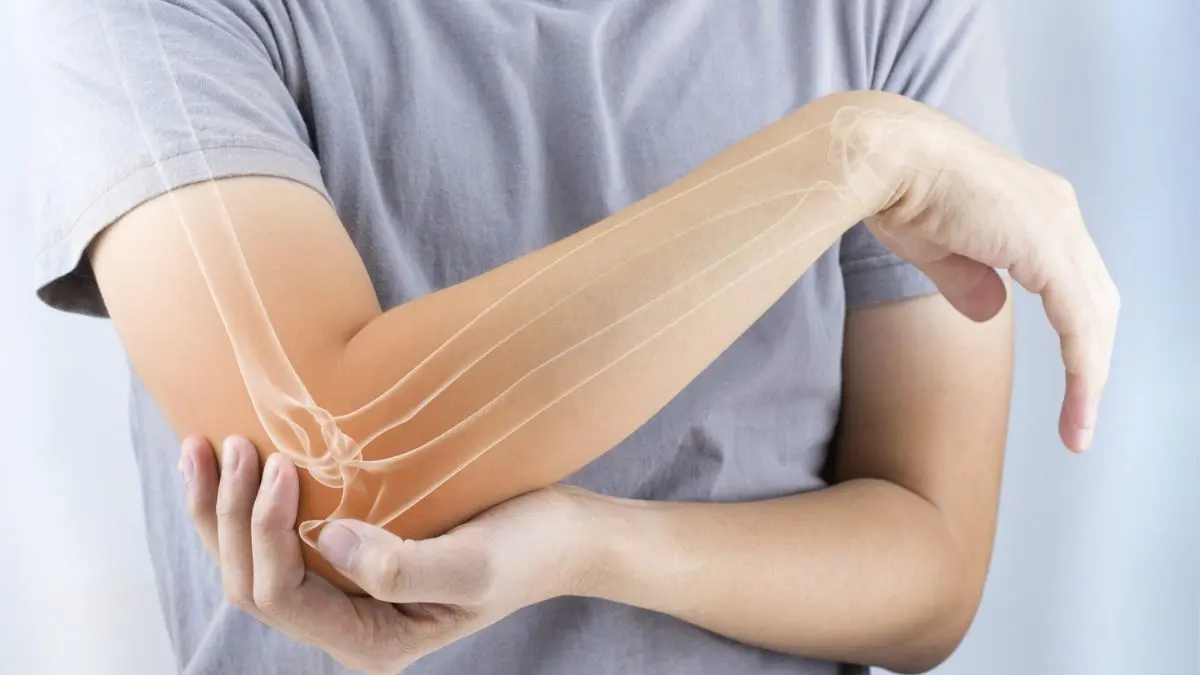
Elbow dislocation is an injury that occurs, most recently in a high-profile athlete – Jayden Daniels
I am not involved in this athlete’s medical care, treatment, or evaluation. Any comments, impressions, or conclusions regarding this athlete’s condition are based solely on publicly available information and should be considered general observations and medical speculation, not medical advice or a formal clinical assessment.
Anatomy of the Elbow
The elbow is a complex synovial hinge joint consisting of three bones the humerus, ulna, and radius that articulate in two primary places: the humeroulnar and humeroradial joints. These articulations allow flexion and extension of the forearm relative to the arm, and the proximal radioulnar joint allows supination and pronation of the forearm.
Key stabilizing structures of the elbow include:
-
Bony architecture: The trochlea of the humerus engages the trochlear notch of the ulna, and the radial head articulates with the capitulum of the humerus. These deep relationships confer considerable stability.
-
Ligamentous stabilizers: The primary static stabilizers are the anterior bundle of the medial collateral ligament (MCL) and the lateral collateral ligament (LCL) complex (including the lateral ulnar collateral ligament, LUCL). Secondary stabilizers include the joint capsule, radio capitellar joint, and common flexor/extensor tendon origins. Dynamic stabilizers include the anconeus, brachialis, triceps, and biceps muscles
-
Joint capsule and musculature: These provide additional containment and dynamic control, especially during motion and loading.
Because of this robust design, elbow dislocations require significant force or a specific mechanism to overcome its stability.
Mechanism of Injury
Elbow dislocations are often the result of high‑energy trauma or forceful loading through the arm. The most common mechanism involves a fall onto an outstretched hand with the elbow extended or slightly flexed, transmitting force proximally through the forearm and resulting in displacement of the ulna and radius relative to the humerus.
The most frequent pattern is posterolateral dislocation reported in up to ~80 % of cases where the forearm displaces posteriorly relative to the humerus.
In athletes, including contact sports or overhead motions, a combination of valgus stress, axial load, supination/external rotation of the forearm, and varus/rotational torque may precipitate the injury.
Elbow dislocations are often classified as:
- Simple dislocation: No associated fracture, primarily ligamentous injury
- Complex dislocation: Dislocation plus associated fractures (ulna, radius, coronoid, radial head), or neurovascular compromise.
Given the stability of the elbow, associated fractures or soft‑tissue disruption are common, especially in high‑performance athletes.
Application to Jayden Daniels and His Injury
While specific physician‑documented details of Jayden Daniels’s elbow injury may vary, assuming he sustained an elbow dislocation or a variant thereof this anatomical and biomechanical understanding is highly relevant for his evaluation and treatment plan. In his position as a competitive athlete, a dislocation may have resulted from a contact or fall‐type mechanism, possibly during a play involving an extended arm, axial load, or twisting force. The demands of his sport on elbow stability, rapid motion, and forceful loads mean that even a “simple” dislocation may carry greater functional implications.
Factors to consider in his scenario include:
-
Given the high‑performance demands, any ligamentous injury (e.g., to the LUCL or MCL) or micro‑instability might impair throwing, passing, or arm control.
-
Neurovascular assessment is critical in athletes, as even transient compromise can affect recovery and performance.
-
Early mobilization balanced against protection is especially important in athletes to minimize stiffness and restore full function.
-
Return‐to‑sport criteria must consider not only joint stability but also strength, neuromuscular control, and sport‑specific motion demands.
Treatment Principles
Initial Management
Once an elbow dislocation is suspected typically via deformity, pain, inability to move the forearm, and sometimes swelling or bruising a neurovascular examination is essential (check radial/ulnar pulses, capillary refill, ulnar/radial/median nerve territories
Standard imaging includes AP and lateral radiographs of the elbow, and possibly oblique views or CT scans if fracture fragments or joint incongruity is suspected. Reduction (i.e., placing the joint back into alignment) is the first critical step and should be performed urgently by trained personnel (usually under sedation or analgesia) in the emergency setting. OrthoInfo
Post‑reduction imaging ensures proper alignment and absence of incarcerated fragments. Assessment of stability then guides further treatment.
Non‑operative Treatment (Simple Dislocation)
For stable, simple dislocations without fracture or significant ligamentous instability, the contemporary approach emphasizes early motion rather than prolonged immobilization. Studies show early mobilization leads to improved range of motion (ROM) and functional outcomes.
Typical protocol:
-
Brief immobilization in a splint or sling at about 90° flexion for 1‑2 weeks.
-
Followed by controlled passive/active ROM exercises, supervised physical therapy with progression to strengthening as tolerated.
Close follow‑up is imperative to detect any recurrent instability, stiffness, or loss of motion.
Operative Treatment (Complex Dislocation)
Surgery is indicated when reduction is not feasible, when there’s persistent instability, neurovascular injury, significant fractures (e.g., radial head, coronoid, olecranon), or when conservative treatment alone is unlikely to restore functional stability in an athlete
Operative goals include:
-
Reduction of bone fragments and/or fixation of fractures
-
Repair or reconstruction of ligament complexes (especially LCL/LUCL and MCL)
-
Protecting joints and soft tissues while early motion is initiated, often using hinged external fixators or internal bracing in high‑demand athletes.
-
Post‑operative rehab emphasizes early controlled motion to avoid stiffness while maintaining joint stability.
Rehabilitation and Return to Sport
For a high‐level athlete such as Jayden Daniels, successful recovery involves:
-
Early motion within the constraints of stability to limit stiffness and loss of extension/flexion stiffness is the most common complication in dislocated elbows.
-
Progressive strengthening of elbow flexors/extensors, forearm pronators/supinators, and dynamic stabilizers (e.g., anconeus, brachialis) to restore neuromuscular control.
-
Sport‑specific functional training (throwing, passing, high‑velocity arm movements) only when joint stability, strength, and motion approximate pre‑injury status.
-
Monitoring for long‑term risks: post‑traumatic arthritis is possible if joint congruency, motion, or stability are compromised.
Prognosis and Considerations
Most simple elbow dislocations treated appropriately yield good outcomes, with return to pre‐injury function feasible However, in athlete populations the demands are higher and the tolerance for residual deficits is lower. Key prognostic factors include:
-
Degree of initial injury (ligamentous vs. bony injury)
-
Time to reduction and initiation of motion
-
Presence of residual instability or stiffness
-
Quality of rehabilitation, particularly sport‑specific function
Summary Relating to Jayden Daniels
In the context of Jayden Daniels’s injury, if his elbow dislocation was of the posterior/valgus type typical of football players, the above anatomy, mechanism, and treatment roadmap apply directly. Rehabilitation must emphasize rapid restoration of motion (to avoid stiffness), meticulous attention to elbow stability (given the throwing/passing demands), and gradual transition to sport‑specific loading. If his dislocation was simple and managed non‑operatively, early therapy is beneficial; if complex (with fractures or ligament tears), surgical intervention followed by structured rehab may have been required. Ongoing monitoring for residual instability, motion loss, or arthritis is essential given his athletic demands.
Conclusion
In conclusion, an elbow dislocation in an athlete like Jayden Daniels demands careful management not only of bony alignment and ligament repair but also of motion preservation, functional rehabilitation, and eventual return to high‑level sport. Understanding the anatomy, injury patterns, and evidence‑based treatments ensures optimal outcomes and guides expectations for recovery and performance.
For expert evaluation and advanced elbow injury care, trust the specialists at Elite Ortho DMV your partner in restoring strength, stability, and peak performance.
Get expert care before your symptoms progress with Elite Ortho DMV
At Elite Ortho DMV, our advanced surgical techniques are designed to match your body’s unique anatomy helping you move freely and recover faster.