
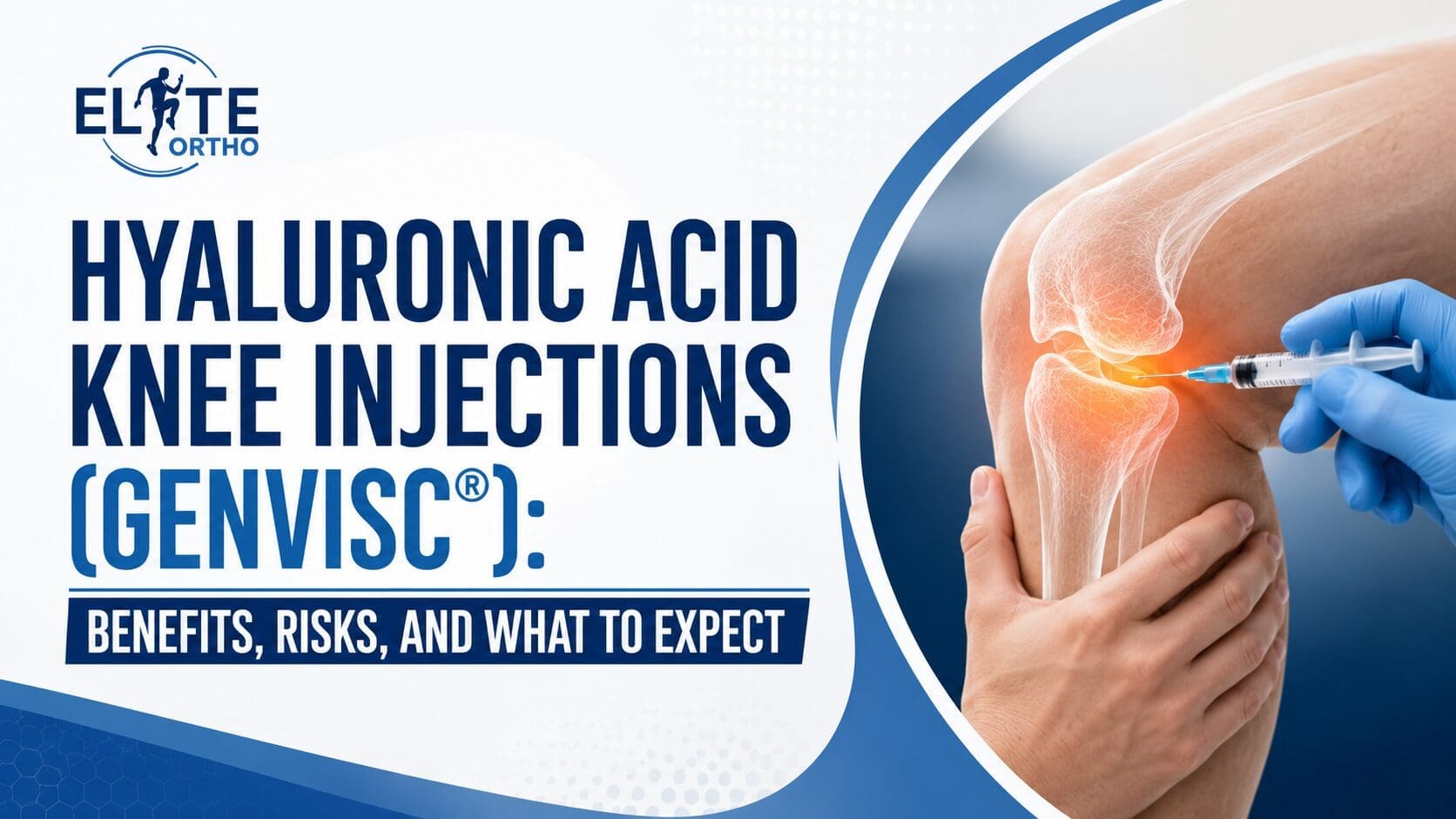
GenVisc® is a hyaluronic acid (HA) injection used to treat pain from knee osteoarthritis when other conservative treatments haven't given enough relief. It's not a cure, and it doesn't work for everyone, but for the right candidate, it can reduce pain and improve mobility without surgery. Here's what it actually does, what it doesn't, and what to expect if you're considering it.
What Is GenVisc® and How Does It Work?
A thick gel-like fluid, called synovial fluid, normally lubricates your knee joint. It provides cushioning to the joint and allows your bones to glide up and down easily. In knee OA, that fluid deteriorates and becomes thinner, and the cartilage rubs against cartilage, leading to pain, stiffness, and swelling.
GenVisc® is directly injected into the knee joint to replenish the fluid. This is termed "viscosupplementation.” The hyaluronic acid in the injection is similar to the one that your body produces, and it's designed to provide temporary lubrication and cushion to the joint.
One type of formulation for knee pain relief is the GenVisc 850 injection, which is used alone or in a brief series, as a doctor may prescribe.
Benefits of Hyaluronic Acid Injections
HA injections are not a fix for arthritis; they don't rebuild cartilage or reverse joint damage. What the evidence supports is more limited and more honest:
- Reduced knee pain during movement and weight-bearing activity for some patients
- Improved joint lubrication, which can ease stiffness
- A non-surgical option for patients who've exhausted basic conservative care
- Relief that may allow patients to delay or avoid more invasive interventions
This is one option among several conservative treatments for knee osteoarthritis, and it's typically considered after other measures, physical therapy, weight management, and anti-inflammatory medication, haven't given enough relief on their own.
Response varies significantly by patient. Some people get real, noticeable relief. Others get minimal to no benefit. There's no reliable way to predict in advance which group you'll fall into.
Risks and Side Effects
This is a medical procedure, not a supplement, and it carries real risks you should know before agreeing to it.
Common side effects:
- Pain, swelling, or warmth at the injection site
- Mild joint stiffness for a day or two after injection
- Bruising around the injection area
Less common but more serious:
- Joint infection
- Significant fluid buildup in the knee
- Allergic reaction, particularly in patients with known sensitivity to hyaluronan or avian proteins (some HA formulations are derived from rooster combs; ask your provider about the specific source used in GenVisc)
Who should not get this injection:
- Anyone with an active knee joint infection or skin infection near the injection site
- Patients with a known allergy to hyaluronic acid or related compounds
- Patients with certain uncontrolled bleeding disorders, without medical clearance first
When to call your doctor after the injection:
- Increasing pain, redness, or swelling more than 48 hours after injection
- Fever
- Fluid that looks cloudy or feels hot to the touch at the joint
If any of these happen, this isn't a "wait and see" situation; contact your provider directly.
What to Expect During Treatment
The procedure itself is done in-office and takes only a few minutes.
- Your doctor will clean the injection site and may use imaging guidance to place the needle accurately in the joint space
- Depending on the formulation, you may receive a single injection or a short series over several weeks
- Mild soreness for 24–48 hours afterward is normal
- Avoid high-impact activity (running, heavy lifting) for the first day or two, per your provider's specific instructions
Relief is not immediate. The injection needs time to integrate into the joint before you notice a difference, so don't expect same-day results. When it works, the effect is temporary — symptoms eventually return, at which point a repeat treatment may be considered based on your doctor's evaluation.
Is This the Right Knee Osteoarthritis Treatment for You?
HA injections make sense for some patients and not others. Be honest with yourself and your provider about where you fall.
You may be a reasonable candidate if:
- You have mild to moderate knee osteoarthritis confirmed by imaging
- You've already tried physical therapy, weight management, or anti-inflammatory medication without enough relief
- You want to delay or avoid knee-replacement surgery
- You don't have an active infection or known allergy to HA
You should consider other options first if
- Your osteoarthritis is severe with significant bone-on-bone contact; injections are unlikely to help much at that stage
- You haven't tried lower-risk, lower-cost options yet, like structured physical therapy or weight loss
- You're looking for a permanent fix. HA injections are a temporary management tool, not a structural repair
Cortisone injections, physical therapy, weight management, and eventually surgical options (like partial or total knee replacement) all remain on the table depending on how advanced your arthritis is. HA injections are one option among several, not a default first step or a last resort.
Next Step
If you're dealing with knee osteoarthritis and want to know whether GenVisc® is a reasonable option for your specific case, the next step is a real evaluation, not guessing based on what worked for someone else. Schedule a consultation with Elite Ortho DMV to review your imaging, treatment history, and options.
Frequently Asked questions (FAQs)
How long does a GenVisc® injection last?
Relief duration varies by patient and isn't guaranteed to be permanent. Some patients need repeat injections to maintain benefit, and your doctor can review what to expect based on your specific joint condition and treatment history.
Is GenVisc 850 injection knee pain relief guaranteed to work?
No. Response to hyaluronic acid injections varies significantly between patients, and some people experience little to no improvement. Your doctor can help assess whether you're likely to be a good candidate based on your specific joint condition.
Can I get hyaluronic acid injections if I’ve had cortisone shots before?
Often yes, but timing matters. Talk to your provider about how much time should pass between different types of injections in the same joint.
Get expert care before your symptoms progress with Elite Ortho DMV
At Elite Ortho DMV, our advanced surgical techniques are designed to match your body’s unique anatomy helping you move freely and recover faster.